Loading...
ADHD & Autism in Adults
ADHD and autism therapy for adults in Colchester — affirmative, sensory-aware, stimming welcome.
Psychodynamic therapy for neurodivergent adults in Colchester and online. For people who've been late-diagnosed, self-identified, or finally had the words for it after their child's assessment.
If you're reading this, you might already know
You might have been diagnosed recently. You might be self-identified and reading everything you can. You might have spent forty years being told you were lazy, too sensitive, too much, or not enough — and somewhere along the way you started to believe it.
I work with neurodivergent adults who are tired of masking, tired of being told to try harder, and looking for a therapist who isn't going to treat ADHD or autism as a problem to be solved.
How I work
My practice is affirmative. That means I start from the assumption that your brain works the way it works, and the goal isn't to make it look like a neurotypical one. The goal is to understand how you actually function, what's been costing you, what's been hidden, and what would make your life feel more like your own.
I've completed specific post-qualification training in neurodiversity, alongside my MA in Psychodynamic Psychotherapy. I've worked in SEN provision at Sir Bobby Robson School in Ipswich and in primary and secondary schools with Mind and the YMCA. Most of what I've learned, though, has come from working with neurodivergent clients in private practice — many of whom knew more about their own neurotype than any textbook I could read.
What I don't do
I don't do ADHD or autism “coaching” — I'm a therapist, not a behavioural trainer. I don't try to reduce stimming, eye contact avoidance, or other regulating behaviours. I don't require a formal diagnosis for you to work with me. And I don't pathologise the parts of you that are actually adaptations to a world that wasn't built for your brain.
The room matters
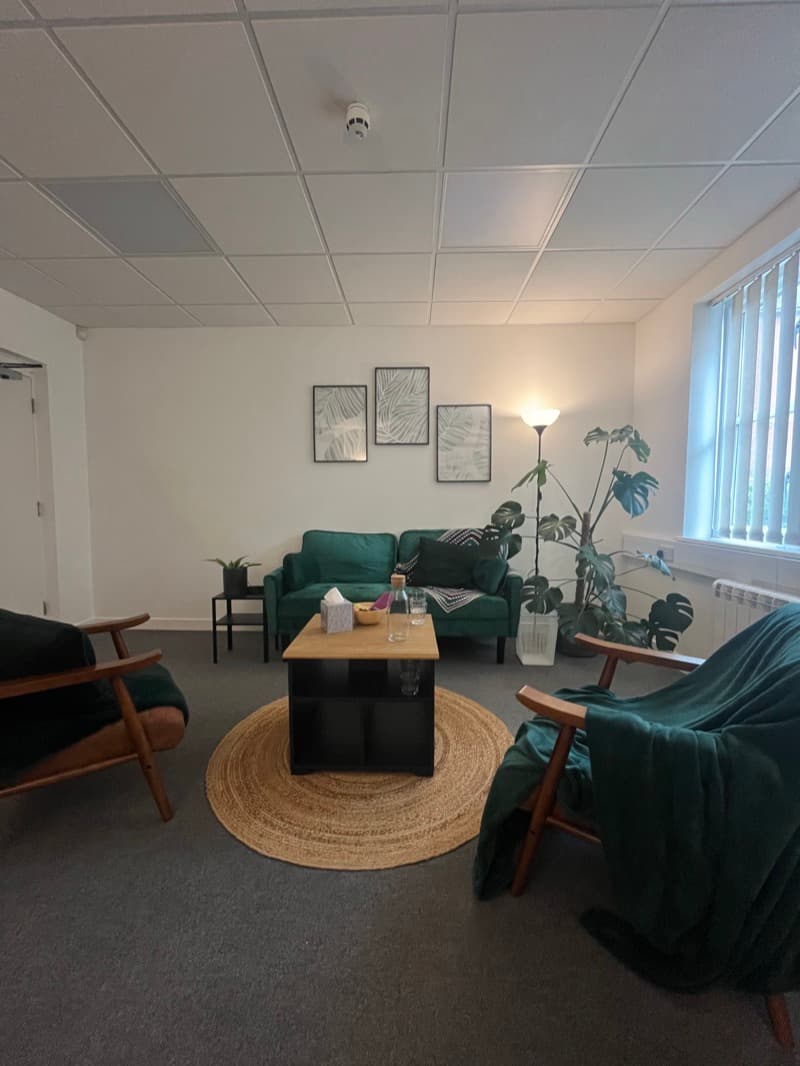
My therapy room is on the ground floor at Colchester Business Centre. It's quiet, it has plants, and the lighting is soft — none of the fluorescent overheads you get in most clinical settings. There's a couch, two comfortable chairs, and a desk with fidgets on it. Stimming is welcome. You don't have to sit still. You don't have to make eye contact. You can move around if you need to, bring a drink, take breaks, or ask me to repeat something.
None of this is a gimmick. Sensory environment matters for neurodivergent clients, and I designed the room knowing that.
What neurodivergent adults often come to me with
- Burnout from masking — the exhaustion that comes from years of performing neurotypical
- Late diagnosis grief and relief— the strange double-feeling of “I finally understand” and “I've lost so much time”
- Anxiety and overwhelm — sensory, social, or both
- Relationship difficulties — especially mixed-neurotype relationships and family dynamics
- Rejection sensitivity— the pain that doesn't match the situation
- Identity — who were you before you started masking, and who are you now
- Executive function and self-compassion — not skills-based coaching, but the emotional work underneath the struggle
- Parenting a neurodivergent child while being one yourself — the exhaustion no one talks about
You don't need a formal diagnosis
If you've identified yourself as autistic, ADHD, or both — that's enough for me. NHS waiting lists for assessment are years long and private assessment is expensive. I work with self-identified clients, and I treat your understanding of your own neurotype as credible.
Online therapy for neurodivergent adults
I work online on Wednesdays, UK-wide, for clients aged 16 and over. For a lot of neurodivergent adults, online therapy is more accessible than in-person — no commute, familiar environment, ability to fidget off-camera, no fluorescent waiting room. If that's what works for you, it works for me.
More about online therapy →Start with a free 15-minute call
If you want to ask about the approach, the room, online options, or anything else — the free call is the place to do it. It's 15 minutes, informal, and you can ask absolutely anything.
Book a Free 15-Minute CallLast updated: